
If you've dealt with a stubborn toenail problem for years, you already know the routine. You try the cream. You try the drops. You try the internet remedies: the vinegar soak, the tea tree oil, the vapor rub your neighbor swore by. Something seems to help for a week or two. Then you look down, and it's right back where it started.
You've probably told yourself the quiet thing most people in your shoes tell themselves: maybe it's me. Maybe I didn't do it long enough, or right enough, or often enough.
According to Dr. James Carter, an integrative physician who spent more than three decades treating patients in Nashville, that quiet thought is the one thing he most wants people to let go of. In his experience, the reason those home remedies fail usually has nothing to do with effort. It has everything to do with a detail almost everyone gets wrong.
“The people who came to me had done everything right. And still, it kept coming back. Eventually I realized I had it backwards.” — Dr. James Carter
“The people who came to me had done everything right,” Dr. Carter says. “They followed instructions. They were consistent. They were not lazy, and it was not about hygiene. And still, it kept coming back. For years I assumed the treatments were fine and something was different about the patient. Eventually I realized I had it backwards.”
That reversal is worth sitting with, because it lifts a burden a lot of people have been carrying. A toenail issue that keeps returning is not a report card on your cleanliness or your discipline. In Dr. Carter's view, it's a sign that the usual approach was aimed at the wrong place to begin with.
▶See the one detail he says changes everything →The most famous home remedy — and why it usually does nothing
Take the most famous home remedy of them all: apple cider vinegar.
Almost everyone with a nail problem has tried it. And almost everyone has watched it do nothing. For most people, that's the end of the story: one more thing that “doesn't work.”
But Dr. Carter came to believe the vinegar was never really the problem. “The remedy wasn't wrong,” he says. “The way people use it is what makes it useless.” Nearly everyone, he points out, does the exact same thing: they dilute the vinegar in water. And that one habit, he argues, may be the reason it slides right off and never reaches what it's supposed to reach.
Why would water be the issue? The answer sent him back to a kitchen he hadn't thought about in years.
A pantry in rural Tennessee

Dr. Carter grew up in rural Tennessee, raised by his grandparents. There was no doctor nearby. What they had was a pantry: apple cider vinegar, herbs from the backyard, remedies passed down through the family.
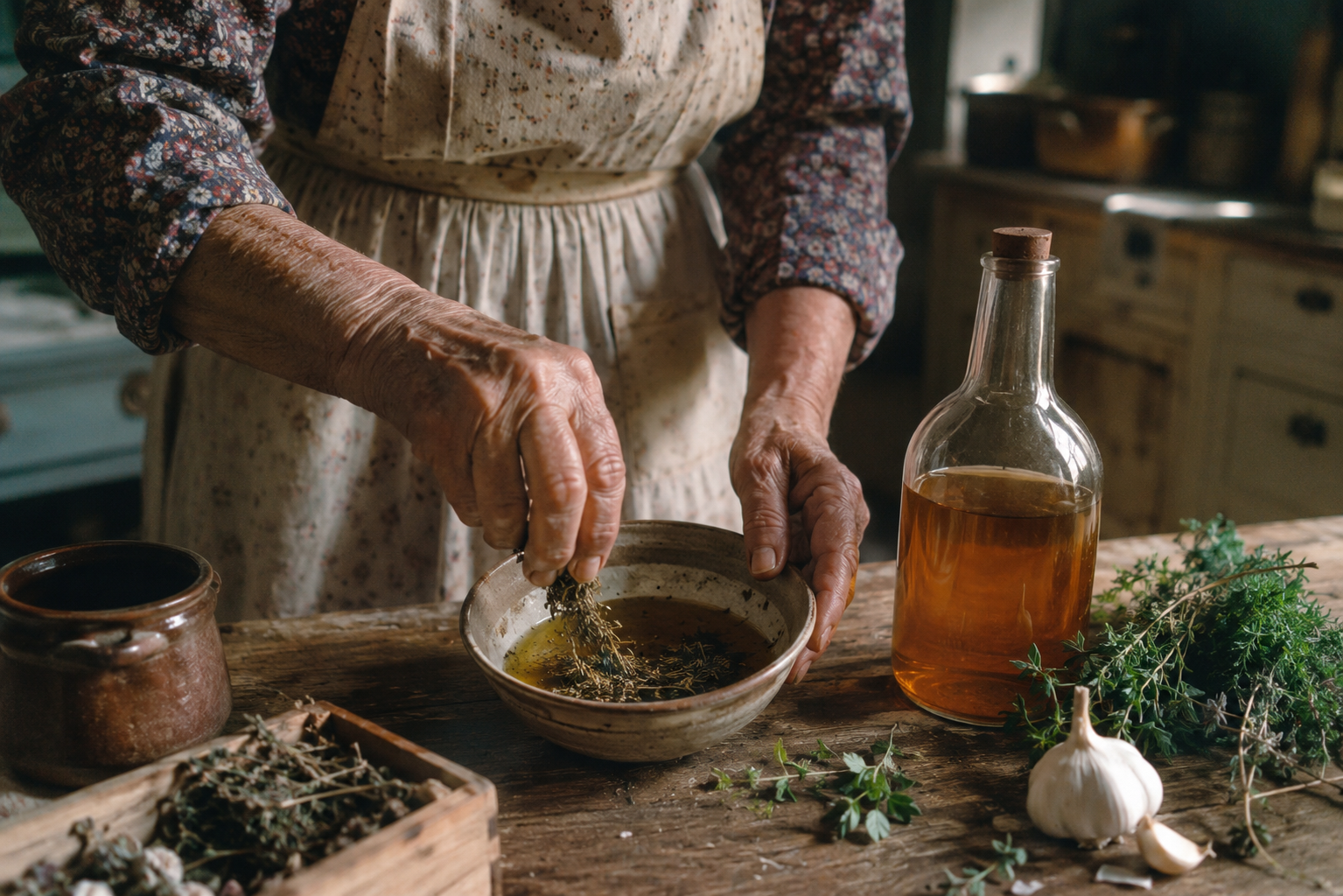
His grandmother had her own way of handling nail trouble. She called it her apple cider vinegar trick. But, as he remembers it, she never once mixed it with water. She combined the vinegar with herbs and worked it into an oil base, then applied it directly and let it sit for hours.
For most of his career, he filed that away as country folklore, a charming habit with no science behind it. “I had thirty-five years of medical training,” he says. “I didn't think I needed my grandmother's kitchen.” It took a long, frustrating stretch of watching patients come back, year after year, before he let himself ask a question he'd never asked: what if she understood something I didn't?
▶Watch Dr. Carter's presentationThe detail he'd dismissed for decades
What he started reading changed how he thought about the whole problem.
Researchers have described how stubborn fungus can shelter itself behind a filmy, protective layer, a kind of barrier that clings to it and makes it remarkably hard to reach. And here's the detail that stopped Dr. Carter cold: that barrier, he explains, behaves like something oily. That means most creams, most drops, and even vinegar diluted in water are all water-based, and all of them tend to bead up and slide off before they ever get close. Like water off a waxed surface.

“Once I understood that,” he says, “everything my grandmother did made sense. She wasn't using water. She was using an oil base. That's the whole difference.”
Fat, in other words, doesn't slide off fat. And that single idea, that the carrier might matter more than the ingredient, reframed a question he'd been getting wrong for decades.
The brother-in-law who had given up
The first person he tried a version of this on was his own brother-in-law, Robert, a proud, skeptical man who had spent years trying everything and had, by his own admission, given up. “One more thing isn't going to change anything,” Robert told him.
Dr. Carter says the first thing Robert noticed, within the first week or two, wasn't visual at all. It was that a certain odor he'd lived with simply faded. Over the following weeks, Robert reported other small changes. Months later, Dr. Carter recalls him mentioning, almost in passing, that he'd stood barefoot at the edge of a pool with his grandchildren without thinking about his feet for the first time in years.
One person's experience. Individual results vary.

For a lot of people, this isn't really about a toenail. It's about the sandals that stay in the closet, the pedicure appointment that never gets booked, the small hesitation before taking your shoes off at someone's house. Those are the things people quietly give up, one by one, and often don't talk about.
Which is why the idea that a familiar remedy might have been on the right track, just used the wrong way, is worth a closer look before writing it off for good.
▶See the one detail he says changes everything →What he does with it now
Dr. Carter has since gone much further than his grandmother's rough recipe. He worked out which specific compounds belong in that oil base, in what balance, and why each one matters. In a short presentation he recorded, he lays out the full story: how he pieced it together, what his grandmother actually mixed, and the exact approach he now recommends.
If you've tried the vinegar, the creams, and the rest and been ready to give up, his explanation of why they slid off, and what finally doesn't, is worth hearing in his own words.
Dr. Carter explains, in his own words, why the usual approach slides off, and what he uses instead.
▶ Watch Dr. Carter's presentation